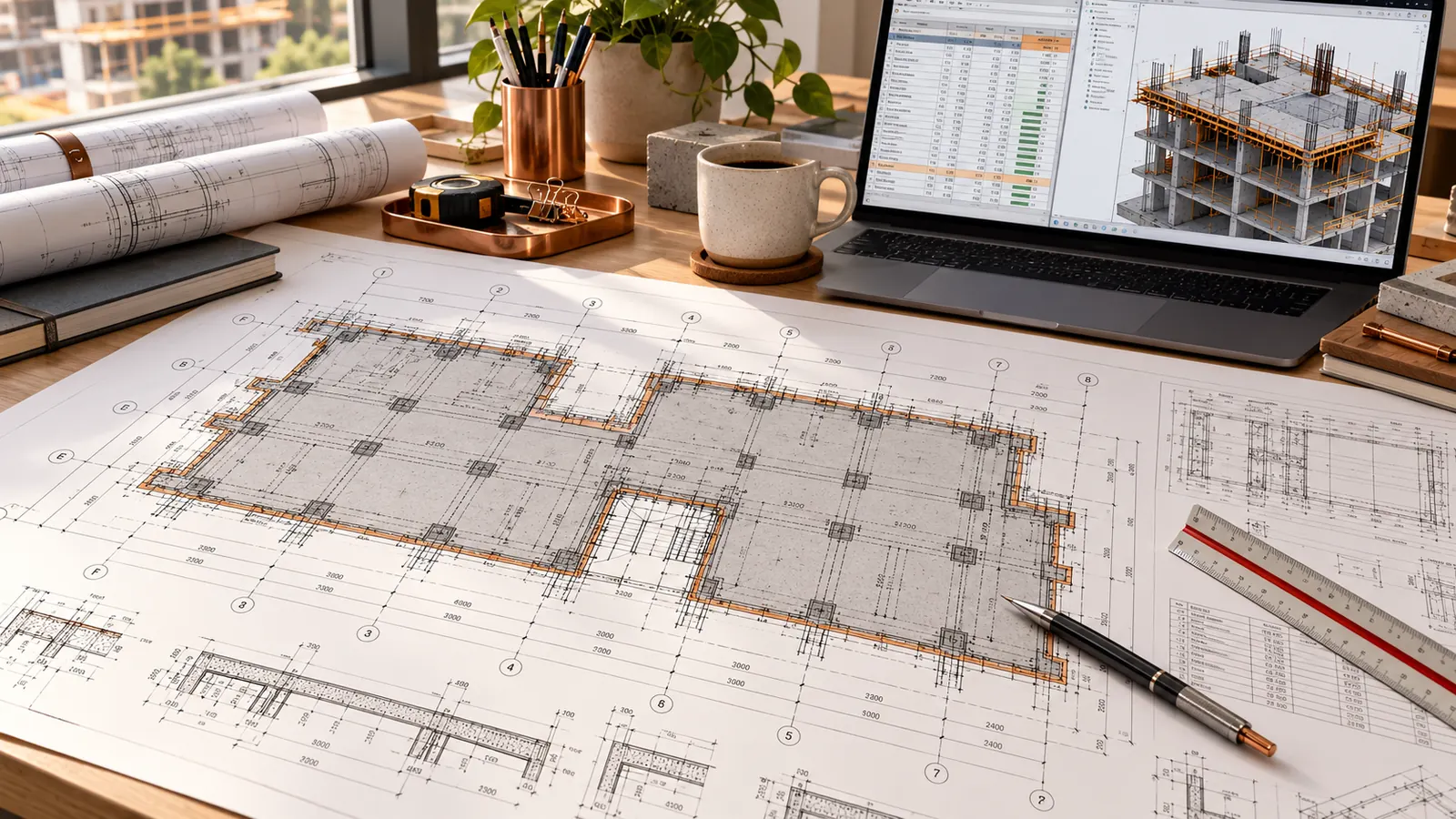
The concept design estimate showed one figure; the developed design estimate shows another three months later. The client asks why. Every specialist knows their own change, and nobody can show the effect of the whole, with evidence. With AI, construction take-off and estimating is not about producing a number. It is about keeping an estimate consistent with a project that keeps moving. The tool brings the documents alongside each other. It knows neither the market rate, nor a contractor’s real output, nor the conditions on your site.
The workshop · a worked case
A take-off is justified line by line.
| Item | Measurement rule | Geometric quantity |
|---|---|---|
| S01 · gross slab | 12.00 × 8.00 | 96.00 m² |
| O01 · deduction | −2.00 × 2.00 | −4.00 m² |
| S01 · net concrete | (96.00 − 4.00) × 0.20 | 18.40 m³ |
This take-off covers the slab only: beams and ancillary works are out of scope. The deduction is applied once.
Try the export clean-up from the book.
P01: 12 m² · P02: 15 m² · P03: 18 m² · P03: 18 m² · P04: 10 m.
The second occurrence of P03 is excluded once confirmed, and recorded in the log. P04 is still to be clarified: metres do not add to square metres.
Fictional teaching example · Adapt it to the data and the scope of your own commission.
01 · Identify what has changed in the estimate
Chapter 11 of the book identifies six things that move, each with its own risk:
- the geometry: the quantity is out of date;
- the specification: the unit rate no longer matches;
- the scope: an item is missed or counted twice;
- the programme: the rate is no longer at the right date;
- the location: transport and productivity are no longer comparable;
- the design: the effect of a local change is not carried through to the total.
The tool is there to spot those mismatches between documents: a quantity that changed while its cost line did not follow, an old rate still in use.
02 · Give every line a stable identity
Before any request, build the cost register. Every line carries a stable identifier, the package, the description, the unit, the quantity and its source, the unit rate and its source, the price date, the zone, what the rate covers (supply and fix, excluding temporary works…), the status and the owner.
The stable identifier lets you follow an item from one stage to the next, even when its wording changes. Two similar descriptions do not necessarily mean the same item.
You can ask the tool to build this register from your current estimate, without altering a single amount, flagging missing fields, ambiguous units and rates with no provenance. Then check in your spreadsheet that the number of lines and the total are identical to the original. Compare a few lines at random, and every line that carries most of the value. The list of flags becomes your work list.
03 · Prepare the quantities from verified sources
The tool extracts quantity tables, reads schedules, matches descriptions, writes an extraction script. A usable quantity stays attached to a geometry, a measurement rule, a version and a unit.
A quantity visible in the model is not a complete quantity. Temporary works, protection on an occupied site, local making good and access constraints generally do not appear in it. If the model has not been audited, the quantity coming out of it is marked “unverified”. Chapter 12 sets out that fitness-for-use audit: coverage, classification, completeness, units, identifiers, the version queried.
Plate 19 shows the clean-up of an export before totalling, on a fictional teaching example:
Analyse this partitions CSV: P01 12 m²; P02 15 m²; P03 18 m²; P03 18 m²; P04 10 m. Identify duplicates by identifier, without deleting them silently. Isolate incompatible units. For this test, count P03 once, after confirmation. Calculate the total of the areas retained and provide a cleaned file, the log of exclusions and a chart.
What you have to check: confirm the duplicates and the measurement rule. The total covers the export provided; it does not prove that the model covers the whole of the works.
The expected result on this fictional case: 45 m² retained, one duplicate confirmed, one unit to clarify (P04 is in metres, not square metres). Nothing is deleted without a trace: the exclusions log says what was set aside and why.
Plate 45 applies the same logic to a priced breakdown tied to the location drawing. Every line carries a code, a description, a unit, a quantity, a formula, the source reference, a unit rate and an amount. The rates stay empty. Items with insufficient information stay “to be established”. The risk of double counting is flagged, and the missing items to investigate are listed. The check is a reminder that geometric quantities are not a settled contract sum.
04 · Demand the provenance of every rate
This is the main risk. In the book’s fictional example, the tool had suggested a range for strengthening with carbon laminates. The first draft of the developed design estimate carries over the mid-point of that range: €135/m². The line looks clean, sits consistently with its neighbours, and has no source whatsoever.
The three usual checks do not catch it. A read-through finds nothing, because a rate is only digits. The order of magnitude passes, since a generated rate lands precisely within the expected order of magnitude. Internal consistency passes too.
The check that works is provenance. Every rate carries its identity card:
- nature: sourced, carried over, ratio, expert judgement;
- exact source and edition: price book, quotation, historical data;
- price date;
- place and market;
- unit and content: supply, fixing, ancillary works;
- what it excludes.
The €135/m² fills in none of those boxes. It goes back to being an assumption to be sourced: a quotation from a specialist contractor, the practice’s own historical data, or a dated price book. Filter the register for lines with no source, work through them in descending order of value, and flag any unsourced line as an assumption in the estimate you issue. If two errors cancel out and give the right total, the estimate is still wrong.
05 · Explain the movement, and look for omissions
In the book’s fictional example, the estimate goes from €6.80m to €7.23m net. Announcing “+€430k” does not answer the client. From the two registers, the tool breaks the movement down line by line into five causes: quantity effect, rate effect, scope effect, indexation, correction, each with its evidence. It isolates the residual it cannot attach to any cause: €70k in the example.
The residual is the most important line in the table. It is presented as unexplained, with the date by which it will be explained, and is not spread across the other items. Redo the sums in your spreadsheet: the effects and the residual must add back to the total movement. Keep the concept design estimate intact: it is another stage, not a superseded revision.
An estimate can also be right and incomplete. The book proposes four cross-checks: specification against estimate, model against estimate, packages against interfaces, previous version against current version. On the school example, three items come out: protection of occupied rooms, temporary accommodation, removal of the old benches. A flag is not proof of an omission: you open the document and clause cited, look for another description, and check with the package owner. Consistency between the specification and the priced breakdown is also covered in the article on writing a specification.
06 · Have the amount and its assumptions approved
The calculation does not happen in the conversation. It happens in a spreadsheet, in cost planning software or in a script, where totals, factors and indexation re-run when a quantity changes. The tool checks the numbers; you set them. A range is decided, not generated. A rate does not transfer from one region or country to another through a simple factor.
What remains yours: having the rates sourced, deciding on every missing item (claim it, absorb it or make an allowance), setting the ranges, presenting the residual as it is, signing the estimate. No amount goes to the client without human approval.
An estimate is a sensitive document. Upload it only to a professional account approved by your organisation, with the model-training clause verified (chapter 3). Anonymising matters mainly for copies that leave the job.
The same demand for traceability applies to calculations: see AI and structural design calculations and the book’s prompts for engineers.
Author of “AI for Architecture and Engineering”.
One approach: document the inputs, produce, check, decide.